
Biodiversity Conservation of Loktak Lake
Biodiversity Conservation of Loktak Lake refers to efforts aimed at protecting and sustaining the rich ecosystem of Loktak Lake, the largest freshwater lake in Northeast India. The lake is known for its unique floating vegetation called phumdis and is home to diverse flora and fauna, including the endangered Sangai.
Written By:
Admin
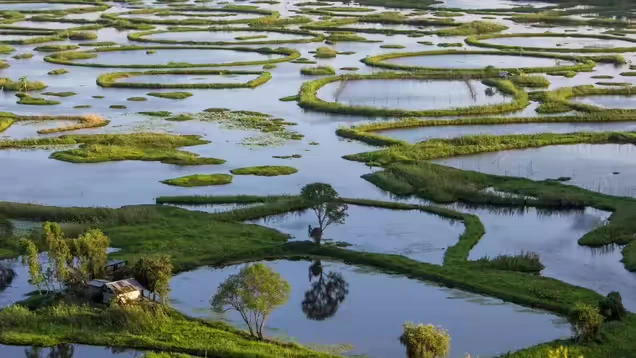
Loktak Lake, the largest freshwater lake in north eastern India is situated between 930 46’ to 930 55’E longitudes and 240 25’ to 240 42’N latitudes in the State of Manipur. It is a Ramsar site, and plays an important role in the ecological and economic security of the region. Loktak Lake covers an area of about 286 Sq.km. at the elevation of 768.5 meter and is a shallow water lake, the depth of which during dry season ranges between 0.5 m to 1.5 m. The characteristic feature of the lake is the presence of floating islands covered with vegetation locally known as phumdis. They occur in all sizes and thicknesses and they are heterogeneous mass of soil, vegetation and organic matter at various stages of decomposition. They harbour several plant species and support a rich biological diversity. The Keibul Lamjao National park (KNLP) is the largest contiguous mass of phumdis providing natural habitat for the highly endangered ungulate species, Cervus eldi eldi locally called the ‘ Sangai’.
← Prev
Next →
Contact us today for a no-obligation consultation. Partner with experienced geospatial professionals to transform your spatial data into actionable insights. From infrastructure planning to environmental analysis, we deliver precision-driven GIS solutions.